NATO’s 3% Question: Why the Hague Summit Matters More Than the Headline Number Suggests
The Structural Problem Behind the Numbers
The NATO Summit scheduled for The Hague in June 2025 arrives at a strange moment in alliance history. For the first time since the 2014 Wales Summit formalized a collective 2% GDP defense spending pledge, the conversation has shifted decisively toward raising that baseline. The question on the table is whether 3% of GDP should become the new expectation. This sounds like a simple mathematical exercise, but understanding why this moment matters requires stepping back from the immediate policy debate to look at the structural forces that made this conversation inevitable.
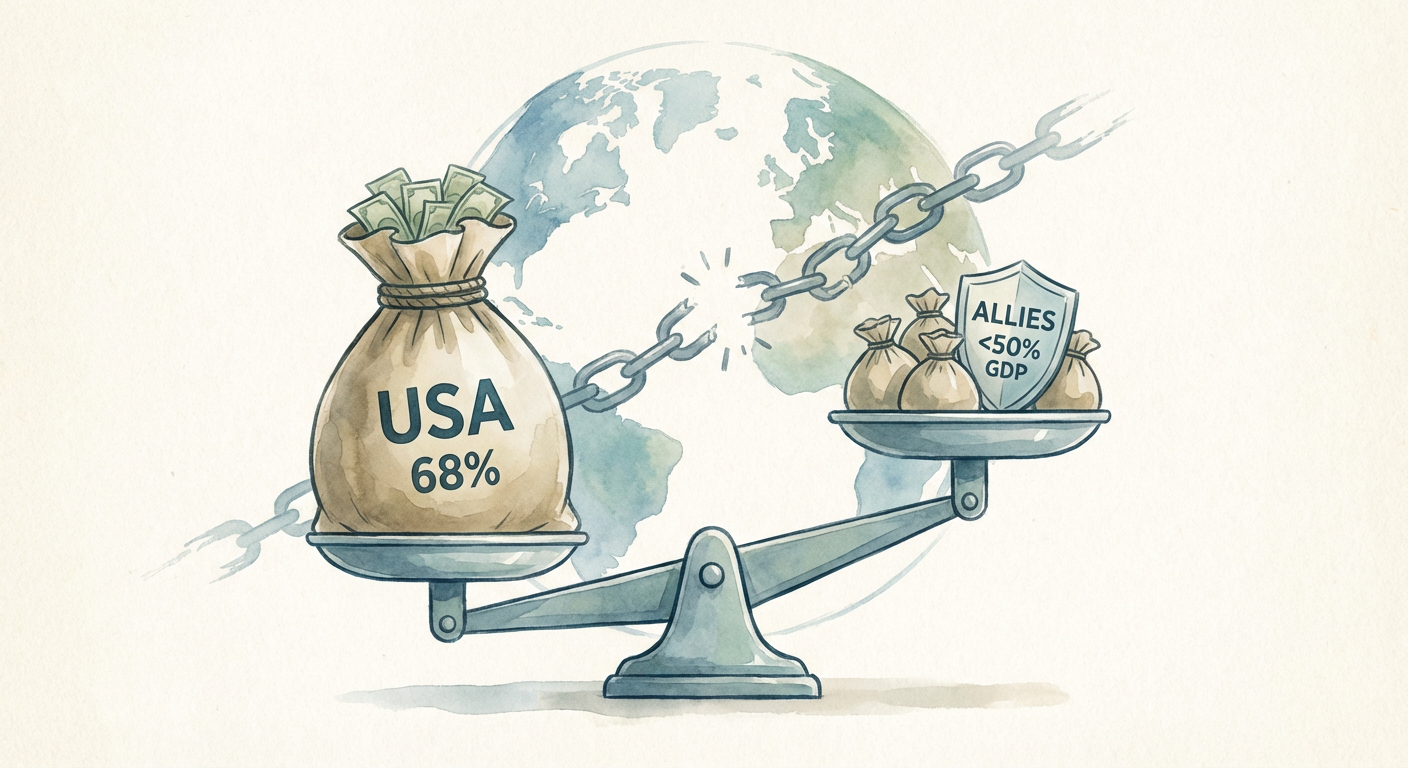
Start with the baseline reality: as of 2024-2025, NATO estimates show that 23 of the alliance’s 32 member states met or exceeded the 2% threshold. That’s genuine progress. A decade earlier, in 2014, only three NATO members were meeting the 2% commitment. By almost any measure, this trajectory reflects a real reorientation of European defense priorities, particularly following Russia’s 2022 invasion of Ukraine. Yet this progress exists alongside a more troubling structural feature that no compliance statistics can obscure: the United States carried approximately 68% of NATO’s total defense expenditure in 2024 despite representing less than half of the alliance’s combined GDP. This asymmetry isn’t new, but its political salience has intensified dramatically, reshaping how both American policymakers and European capitals think about alliance sustainability.
The burden-sharing question has always been structural rather than merely budgetary. When American officials emphasize disparities in defense spending, they’re not primarily concerned with absolute numbers. They’re expressing anxiety about whether the alliance reflects a genuine collective commitment or whether it amounts to a security subsidy flowing from Washington to Europe. The 2% pledge was itself a political compromise designed to address this anxiety without triggering the much more contentious debate about whether NATO members should spend comparable percentages of their national wealth on defense. But now that 23 members have met or exceeded 2%, that compromise looks increasingly insufficient as a framework for understanding alliance burden-sharing.
The Post-2022 Reorientation: When Strategic Urgency Meets Political Consensus
To understand why a 3% discussion is happening now, you need to look at what changed between 2022 and 2025. Russia’s invasion of Ukraine didn’t create the structural burden-sharing problem, but it did something more consequential: it created political permission for European governments to dramatically increase defense spending without facing domestic resistance. This is a distinction worth taking seriously. A Pew Research Center survey from February 2025 found majorities in most NATO European member states supporting increased defense spending, a marked shift from pre-2022 polling, when defense spending increases consistently faced skepticism or outright opposition in many Western European publics.
Poland exemplifies this transformation most clearly. As of 2025, Poland allocates approximately 4% of GDP to defense, the highest proportion among NATO allies. This figure reflects not a sudden policy innovation but a structural consensus across Poland’s domestic political spectrum that border proximity to the Russia-Ukraine conflict demands sustained security investment. What makes Poland analytically useful is that its defense posture reshapes the entire burden-sharing conversation. When your neighbor is engaged in active military conflict with Russia, discussions about whether defense spending increases are fiscally prudent or politically necessary take on a different character entirely. The Polish example demonstrates that 3% spending isn’t theoretically implausible or economically catastrophic for NATO members. It’s politically achievable when strategic urgency aligns with clear threat perception.
But the analysis has to resist oversimplification here. Poland’s situation isn’t representative of most NATO members. Germany, France, Italy, and Canada face substantially different strategic calculations, different fiscal constraints, and different domestic political pressures than Poland does. Any expansion of burden-sharing expectations has to account for this heterogeneity within the alliance. A 3% threshold might make sense for frontline states and still represent an unrealistic expectation for members who perceive lower direct threats. That’s not an argument against increasing defense spending in Europe, but it is a recognition that treating all 32 NATO members as if they face identical strategic imperatives produces both analytically incomplete and politically fragile policy frameworks.
The American Leverage Question: Burden-Sharing as Political Pressure
Understanding the American role in the 3% conversation requires distinguishing between different levels of analysis. At the budgetary level, the Trump administration’s burden-sharing rhetoric reflects genuine frustration with the 68% figure. American defense officials have expressed this frustration consistently across administrations, but the rhetorical intensity attached to burden-sharing increased substantially in 2024-2025. This isn’t primarily about ideology or economic theory. It’s about a structural reality: the United States cannot sustain a security guarantee to 32 countries if American publics increasingly question whether those countries are making proportionate contributions to alliance defense.
The 3% proposal functions as both an analytical metric and a political tool. Analytically, it represents a reasonable attempt to calibrate burden-sharing expectations to match the post-2022 security environment. Politically, it creates a measurable standard against which European performance can be evaluated and potentially used as leverage in broader alliance negotiations. For detailed analysis of NATO’s spending data and historical trends, NATO Defense Expenditure Data and Reports provides comprehensive documentation of member spending patterns and policy guidance.
Here’s the structural complexity though: using burden-sharing expectations as political leverage within an alliance creates its own tensions. If NATO members perceive that meeting spending thresholds is primarily about satisfying American political demands rather than reflecting collective strategic judgment, the political sustainability of those thresholds erodes. Some European leaders have quietly expressed concern that escalating burden-sharing expectations represent not a rational response to changed security conditions but a negotiating tactic. Whether that perception reflects accurate analysis or defensive positioning remains genuinely ambiguous. What is clear is that embedding spending requirements within a framework of American pressure rather than collective alliance deliberation affects how those requirements are received and implemented across member states.
The Structural Constraints on a 3% Consensus
The path from current spending levels to a potential 3% baseline reveals genuine structural constraints that political will alone can’t overcome. Not all NATO members have identical fiscal space for defense increases. Germany’s constitutional debt brake, Italy’s structural fiscal challenges, and Canada’s budget priorities create real constraints on how quickly those countries can increase defense spending. These aren’t excuses or failures of political nerve. They’re structural features of member states’ domestic fiscal and political systems. A credible NATO consensus on 3% spending requires accounting for these differences rather than pretending they don’t exist.
Public opinion data adds important context here. Pew Research Center NATO and European Security Surveys document that while majorities in most European NATO members support increased defense spending, that support varies in intensity and comes with conditions. Europeans support spending increases when they perceive direct threats or when spending priorities align with their own security assessments. They grow more skeptical when increases appear driven primarily by external pressure or when budgetary resources are diverted from domestic priorities that European publics view as equally pressing.
The June 2025 Hague Summit will likely produce some form of consensus on elevated defense spending targets. Whether that consensus crystallizes around 3% or settles on some intermediate formulation remains genuinely uncertain. What seems structurally inevitable is that NATO will move beyond treating 2% as an adequate burden-sharing standard. The question is whether any new standard emerges from collective alliance judgment about the post-2022 security environment, or whether it represents primarily a response to American political pressure. That distinction matters more than the specific percentage ultimately selected.
What the Hague Will and Will Not Resolve
The Hague Summit has the capacity to formalize new spending expectations and potentially reshape NATO burden-sharing arrangements for the next decade. But it won’t resolve the underlying structural tension between American pressure for increased European spending and European governments’ need to maintain fiscal sustainability and public support for defense increases. Those tensions aren’t policy failures or negotiating defeats. They’re features of how democratic alliances actually operate when member states have different strategic interests, different fiscal constraints, and different domestic political contexts.
The Hague will matter because it will set expectations for how NATO conceptualizes burden-sharing going forward. Those expectations will shape defense budgets, influence military planning, and affect how member states prioritize competing fiscal demands. The conversation about

The Accountability Gap: Why Regulatory Oversight Remains Democracy’s Unfinished Business

The Carbon Offset Mirage: How Market-Based Climate Solutions Funnel Wealth Upward, Leaving Communities Behind
Why Carbon Markets Work for Corporations, Not Communities
About Author
