The Carbon Offset Illusion: How Market Mechanisms Serve Corporate Power, Not Communities
The Architecture of a Broken Promise
Carbon markets didn’t just appear. They were stitched together from the ashes of the Kyoto Protocol, a political compromise that let industrialized nations dodge the hard work of cutting emissions at home. The pitch was simple and seductive: let the market find the cheapest way to reduce a ton of carbon. In reality, the system was rigged from the start. A corporation in the Global North could keep its smokestacks billowing, so long as it bought credits from a project—usually in the Global South—that promised to absorb or avoid an equivalent amount of greenhouse gas. The fundamental flaw is that a carbon credit turns a deeply material, local process into a financial abstraction. A ton of carbon not released from a forest in the Democratic Republic of Congo is treated as interchangeable with a ton of carbon pumped into the sky over Texas. It’s a legal and financial fiction, but one that has devastating, concrete consequences for the people who actually live on that land.
Look at the architecture of both compliance markets, like the European Union Emissions Trading System (EU ETS), and the voluntary markets where companies chase net-zero badges. The pattern is consistent. The real money flows to the middlemen: project developers, verifiers, traders, and the corporations that use credits as a license to keep polluting. The communities hosting these projects—Indigenous groups, smallholder farmers, forest-dependent peoples—are an afterthought. They’re often the last to see any money, if they see any at all. The system isn’t malfunctioning. It’s doing exactly what it was designed to do: channeling value upward while pushing risk and displacement downward.

The Colonial Continuity of Land-Based Credits
To grasp why carbon markets fail communities, you have to look at what they do to land tenure. A carbon offset project, especially in forestry or land use, needs control over a defined territory for decades. The logic of “additionality”—proving the carbon savings wouldn’t happen without the project—often means banning traditional land uses. Rotational farming, grazing, collecting firewood: all of it can be criminalized in the name of sequestering carbon. What you get is a classic enclosure of the commons. Communities that have managed these landscapes for generations suddenly find their access cut off, their practices outlawed. The project developer, often a foreign company or a domestic elite with international backing, secures the legal rights to the carbon. The community’s customary rights? Ignored or extinguished.
This isn’t collateral damage. It’s a prerequisite. To sell a forest’s carbon, you first have to strip it of its social and cultural complexity, turning it into a legible, measurable carbon reservoir. The result is a new wave of green grabbing, where conservation and climate action become the justification for dispossession. The revenues from credit sales go to the developer and investors. A fraction might trickle down as community development funds, but these are often paternalistic, dictating what the community can and can’t do, and they rarely compensate for the loss of sovereignty and livelihood. The carbon market doesn’t just fail to help communities; it actively harms them by severing their relationship with the land.
Financializing Pollution: A Corporate Windfall
For corporations, carbon markets are not a burden. They’re a strategic asset. The ability to buy offsets turns climate action from a mandatory operational overhaul into a flexible balance-sheet exercise. A fossil fuel company can keep exploring and extracting, simply purchasing credits from a forestry project to slap a “carbon neutral” label on a product line. The core business model stays intact, and the company gets to market itself as a climate leader. The financialization of carbon creates a new asset class, and the biggest emitters are the ones with the capital to dominate it. They invest in offset projects, trade credits, and lobby to shape the rules of the game.
Carbon credit prices tell the story. In the EU ETS, prices have swung from near zero to over 100 euros a ton, driven by policy shifts and speculation. When prices are low, there’s no real incentive to cut emissions. When prices spike, financial players hoard and trade credits, adding a layer of rent-seeking that does nothing to decarbonize the real economy. Meanwhile, the communities on the ground are locked into long-term contracts with fixed, often exploitative, prices for the carbon stored on their lands. They see none of the speculative upside. The market’s volatility is a risk shouldered by the planet and the people, while the profits are captured by corporations and financiers.

Verification as a Tool of Control
The whole carbon market edifice rests on the credibility of verification. Third-party auditors certify that a project is additional, that the carbon is genuinely sequestered, and that there’s no leakage—meaning emissions aren’t just displaced elsewhere. In theory, this guarantees environmental integrity. In practice, the verification industry is shot through with conflicts of interest. Auditors are paid by the very project developers they’re supposed to independently assess. The methodologies they use are often abstract, relying on models and baselines that can be gamed. A 2023 investigation into Verra, the world’s largest certifier of voluntary carbon credits, found that over 90% of its rainforest credits were likely “phantom credits” that didn’t represent real emissions reductions.
For communities, the verification process is opaque and alienating. Their local knowledge—the health of the forest, signs of biodiversity loss, their experience of drought and fire—doesn’t count as data. Auditors fly in, take measurements, and leave. The community is reduced to a passive subject of a technical process they don’t control. When a project fails—when the forest burns or is logged—it’s often the community that gets blamed, while the developers and verifiers have already collected their fees. The structural power imbalance is absolute: corporations and financiers write the rules, pay the verifiers, and pocket the profits. Communities bear the risks and the blame.
The Net-Zero Shell Game
Corporate net-zero pledges have become the main engine of the voluntary carbon market. Companies across every sector—oil and gas, aviation, agriculture, tech—have announced plans to hit net-zero by 2050 or sooner. But look closely at these pledges, and you’ll see a heavy reliance on offsets rather than deep decarbonization. The Science Based Targets initiative (SBTi) and other standard-setters are still wrestling with what a credible net-zero claim even looks like. In the meantime, corporations are using offsets to claim progress while their absolute emissions keep climbing. This isn’t a glitch. It’s a feature of a system designed to delay the structural changes that would threaten corporate profits.
Buying offsets lets a company claim it’s taking action without changing its supply chain, its energy mix, or its growth model. An airline can buy credits from a forest project and market “carbon-neutral flights,” even as it expands its fleet and lobbies against fuel taxes. A tech company can offset the emissions from its data centers while its overall energy consumption skyrockets. The offset becomes a moral license to keep polluting, and the communities hosting these projects become the unwitting providers of that license. They’re not partners in a just transition. They’re suppliers of a commodity that lets business as usual grind on.
Displacement and the Geography of Sacrifice
The spatial logic of carbon markets draws a clear map of sacrifice. Emissions are generated in the wealthy, industrialized cores of the global economy. The work of sequestration is outsourced to the peripheries—rural areas in the Global South, Indigenous territories, marginalized agricultural regions. This spatial fix lets the core maintain its consumption patterns while the periphery absorbs the environmental and social costs of offset projects. Communities in these sacrifice zones are often promised development, jobs, and revenue. The reality is more often land grabs, restricted access to resources, and the criminalization of traditional livelihoods.
In many cases, the very existence of a carbon project depends on the narrative that the land was mismanaged or degraded before the project arrived. This narrative erases the history of sustainable land use by local communities and justifies the imposition of external control. The project becomes the savior of the forest, and the community is recast as the threat. This discursive violence is then used to legitimize the physical violence of evictions and enforcement. The carbon market, far from being a neutral mechanism, is a tool for reordering space and power in ways that benefit the already powerful.

Reclaiming Climate Justice from the Market
The failure of carbon markets isn’t a reason to give up on climate action. It’s a reason to give up on market-based climate action. The alternative isn’t inaction; it’s a different set of policies rooted in justice and direct regulation. A just transition means the costs of decarbonization are borne by those who’ve profited from emissions, not by those who’ve contributed the least. That means aggressive, binding emissions caps on corporations, paired with massive public investment in renewable energy, public transit, and ecosystem restoration that’s led by communities, not by financiers.
Community-led conservation models, where land rights are secured and local governance is strengthened, have a far better track record of protecting forests and biodiversity than carbon offset projects. These models don’t commodify the forest. They recognize its intrinsic value and the rights of the people who live there. Funding for such initiatives should come from progressive taxation on corporate profits and wealth, not from the sale of carbon credits. The goal should be to keep fossil fuels in the ground and to restore ecosystems, not to create a market that lets you trade one for the other.
FAQ: Unpacking Carbon Market Myths
Don’t carbon markets at least provide some funding for conservation?
The funding that reaches the ground is often a fraction of the credit’s sale price, after developers, verifiers, and traders take their cuts. More importantly, this funding comes with strings attached that can undermine local land rights and self-determination. Direct, unconditional finance for community-led conservation is a more effective and just alternative.
Can’t we just fix the carbon markets with better rules?
The problems are not merely technical; they are structural. The need to commodify carbon inherently requires the abstraction and control of land in ways that conflict with community rights. No amount of tinkering with additionality tests or buffer pools can resolve the fundamental power imbalance between corporations seeking offsets and communities living on the land.
What should corporations do instead of buying offsets?
Corporations should focus on reducing their own emissions across their entire value chain, in line with a 1.5°C pathway. This means investing in energy efficiency, switching to renewables, and fundamentally rethinking carbon-intensive business models. Any remaining emissions should be addressed through contributions to a global loss and damage fund, not through the purchase of offsets that claim to cancel out ongoing pollution.
How do carbon markets affect Indigenous Peoples specifically?
Indigenous Peoples are disproportionately impacted because their territories contain much of the world’s remaining forests. Carbon projects often override Indigenous land tenure systems, imposing external governance structures and restricting traditional practices. The carbon market can thus become a new vector for colonization, undermining Indigenous sovereignty in the name of climate action.

The Structural Flaws of Carbon Markets: How Corporate Gains Undermine Community Resilience
The Offset Mirage: How Carbon Markets Let Polluters Pay to Play While Communities Pay the Price
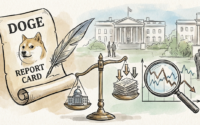
DOGE’s First Year Report Card: What the Data Actually Shows About Federal Workforce Cuts
About Author
