DOGE’s First Year Report Card: What the Data Actually Shows About Federal Workforce Cuts
The Baseline Question: What Are We Actually Measuring?
When we talk about federal workforce reductions, we run into a deceptively simple problem almost immediately. The Department of Government Efficiency, under Elon Musk’s direction, has made bold claims about identifying over $55 billion in potential savings by early 2026. These figures dominate headlines and shape public perception about whether the initiative represents serious fiscal discipline or something closer to accounting theater. But before we can evaluate whether these numbers hold up, we need to agree on what we are actually counting. Are we measuring permanent job eliminations? Early retirements? Unfilled positions? Cancelled contracts? The answer matters enormously, because each represents a different mechanism with different real-world consequences for your neighborhood, your state, and the people who work in federal offices.
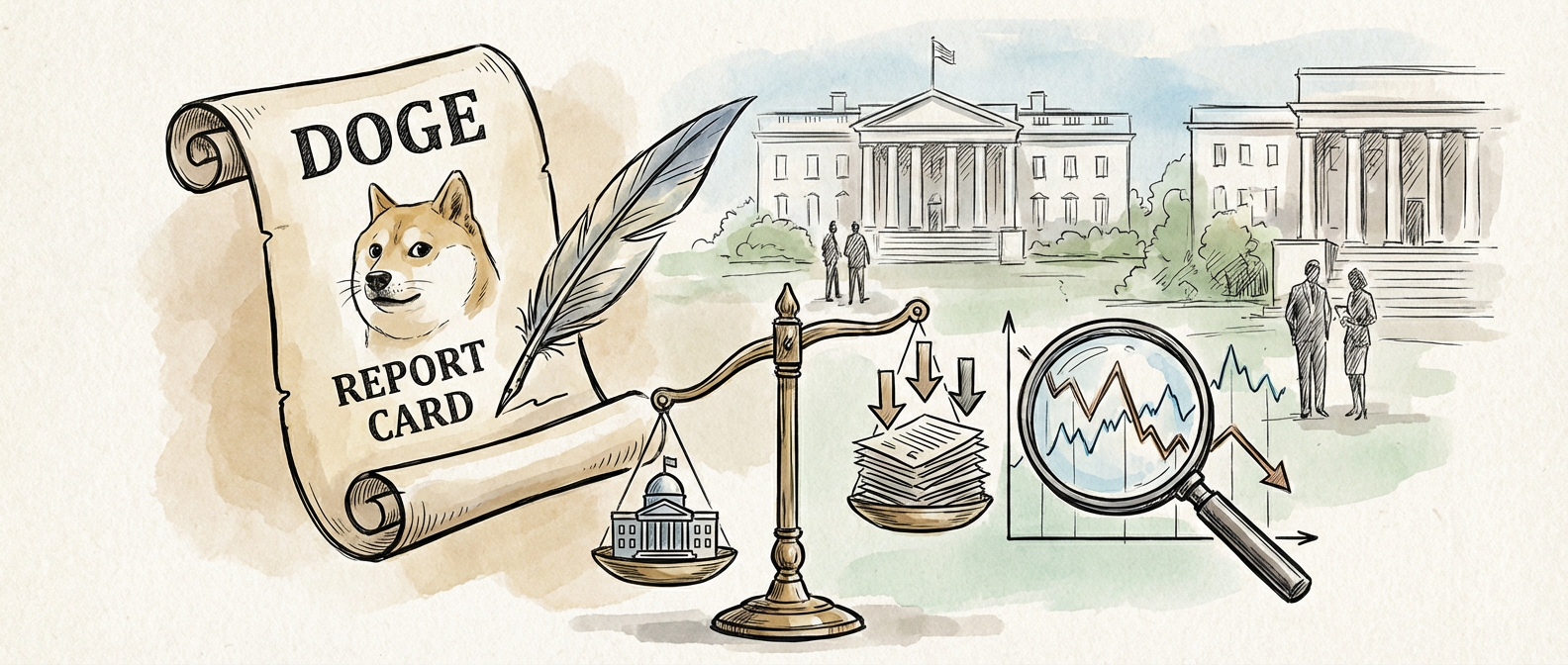
Consider the starting point: approximately 2.3 million civilian federal employees worked across the government when DOGE initiatives began, according to data from the Office of Personnel Management Workforce Data. This figure includes teachers in Defense Department schools, scientists at the National Institutes of Health, Veterans Affairs counselors, Social Security processors, and countless others whose work directly touches American lives. Understanding what portion of this workforce was actually affected requires us to distinguish between announced cuts, negotiated departures, and actual reductions in service capacity. These are not the same thing, and that distinction has real implications for how federal agencies function in your community.

The Resignation Buyout: Numbers That Need Context
One of DOGE’s most visible early moves was offering federal employees a deferred resignation buyout in early 2025. Approximately 75,000 federal employees accepted this offer, which on the surface looks like a significant workforce reduction. This number circulates in political discourse as evidence of successful downsizing. But we need to understand what this figure actually tells us and what it hides. A 75,000-person reduction sounds substantial until you recognize it is roughly 3.3 percent of the total federal workforce. The buyout was also voluntary, meaning it drew from people already considering leaving, those with enough financial security to take early separation, or those approaching retirement anyway.
The real question is: what work went undone as a result of these departures? Did agencies rehire for these positions? Were there actual service reductions, or did existing staff absorb additional workload? A federal investigator might spend more time per case. A National Weather Service office might issue forecasts with less precision. A passport processing center might extend application timelines. These are not abstract concerns. They are the specific ways federal workforce reductions translate into altered services in your state, your county, and potentially your own life. Without detailed agency-by-agency analysis, the 75,000-person figure tells us the size of the exit but nothing reliable about the consequences.
The Savings Claims: Where Independent Analysis Diverges
The $55 billion in claimed savings requires particularly careful scrutiny, because this is where DOGE’s methodology has faced its most serious challenges. Independent analysts at the Congressional Budget Office Federal Workforce Analysis raised significant questions about how this figure was calculated. Specifically, the CBO found that many of the savings DOGE cited involved contract cancellations that had already expired or been completed. You cannot save money by cancelling something that is not costing you anything anymore. This might sound like accounting pedantry, but it reflects a fundamental problem: DOGE appears to have included baseline savings that would have occurred naturally with no new initiative at all.
Beyond the contract cancellation issue, the broader savings claims rely heavily on projections rather than demonstrated results. When someone claims $55 billion in potential savings by early 2026, they are presenting a forecast built on assumptions about how agencies will operate differently. Those assumptions may or may not prove accurate. Personnel might be rehired as workload demands become apparent. Contracts might be renewed after brief gaps. Services might be restored after constituents complain to their representatives. The gap between announced savings and realized savings often proves substantial in federal policy. We are now well into 2026 in many cases, yet comprehensive independent audits of actual savings remain limited. Claims continue to outpace verifiable documentation.
The Legal Obstacles: Courts as a Complicating Factor
One element that received less media attention than the headline claims involved the legal challenges DOGE initiatives faced almost immediately. Multiple federal courts issued injunctions blocking various DOGE-directed agency access orders throughout 2025. These were not merely procedural delays. They represented judicial determinations that certain DOGE directives likely violated statutory requirements, constitutional principles, or administrative law. When a court blocks an executive action, it signals that the action may have exceeded presidential authority, failed to follow required procedures, or conflicted with congressionally established protections.
These injunctions matter for understanding what DOGE actually accomplished versus what it attempted. Some directives never took effect. Others took effect in limited form. Still others were implemented and then reversed. The net result is that the workforce reduction picture is significantly messier than simple headline numbers suggest. An employee might have accepted a buyout, then seen a court order blocking the underlying reorganization, then faced a new directive attempting to accomplish similar goals through different means. That uncertainty created real complications for agency operations, employee morale, and service consistency.
The Ground-Level Reality: What This Means Where You Live
Translating these dynamics into lived experience means thinking about specific agencies in your state and region. If your state has a significant federal employee presence, did those workers depart under the buyout program? Did positions go unfilled? Did hiring freezes remove opportunities for qualified candidates from your community? If your region depends on federal contracting, which contracts were cancelled and what happened to the businesses that depended on them? Did federal employees in your state who stayed face increased workload or reduced benefits? These specific questions matter more than the aggregate national numbers.
The DOGE initiative’s first year ultimately reveals what tends to happen in most federal reform efforts: the reality proves more complicated than either advocates or critics initially acknowledged. Workforce reductions did occur, though perhaps not as dramatically as initial claims suggested. Some savings were achieved, though perhaps not as comprehensively or reliably as promised. Some initiatives ran into legal constraints that limited their implementation. Some services were affected, though the precise nature of those effects remains hard to quantify. A genuine assessment requires moving beyond headlines to examine actual outcomes in specific contexts. What has changed in federal service delivery in your area? Where do you see actual differences, and what remains unverified? The data invites these local, grounded questions far more than it supports sweeping national conclusions.