Mexico Under Claudia Sheinbaum: How the First Female Mexican President Is Navigating Cartel Sovereignty, U.S. Pressure, and MORENA’s Institutional Consolidation
The Judicial Reform Gamble and Its Real Costs
When Claudia Sheinbaum took office on October 1, 2024, she inherited a political machine unlike any her predecessors commanded. MORENA, the leftist party that swept her into power, held supermajorities in both chambers of Congress. Within weeks, that supermajority moved to remake Mexico’s judicial system entirely. By early 2025, the party had pushed through a sweeping constitutional reform that replaced the appointment process for federal judges with direct popular elections. Sixty-five percent of sitting justices on Mexico’s Supreme Court of Justice of the Nation either resigned outright or declined to participate in the retention election. This was not procedural shuffling. This was institutional rupture.
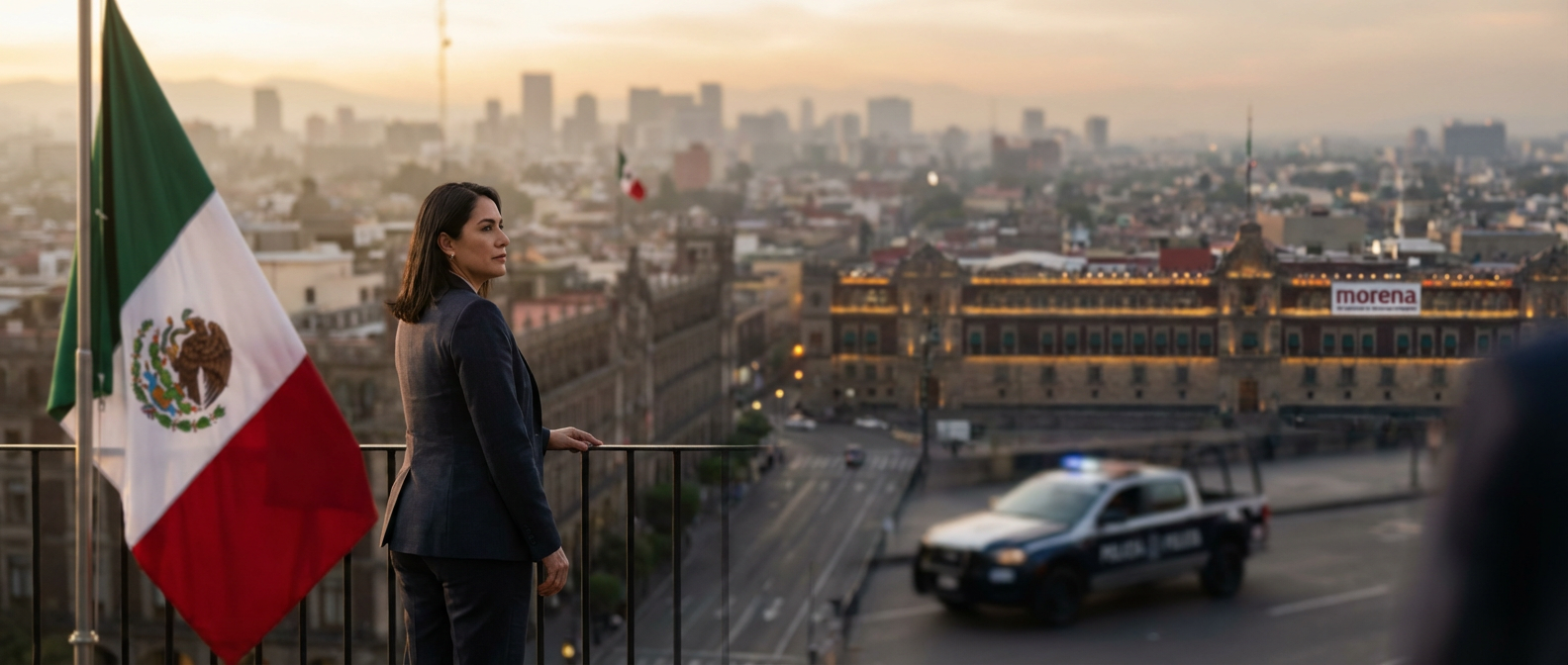
The complications run deeper than the headlines suggested. On the surface, the argument from MORENA proponents sounded populist and democratic: judges should answer to voters, not backroom political dealings. But the State Department formally criticized the reform as undermining rule of law. More significantly, the massive exodus of experienced jurists created administrative vacuums precisely when Mexico needed functional courts to process complex criminal cases, anti-corruption investigations, and commercial disputes. When an institution loses two-thirds of its institutional knowledge simultaneously, the question of legitimacy becomes secondary to the question of capacity. Sheinbaum’s administration argued the transition was temporary pain for long-term democratic gain. Her critics, including significant segments of Mexico’s business community and civil society, worried that what was being built was not a more democratic judiciary but a more pliable one.
The political calculation for Sheinbaum was straightforward: consolidate MORENA’s power while her supermajority lasted. But the institutional consequences will ripple through her entire presidency. A weakened judiciary directly affects her administration’s ability to prosecute white-collar crime, enforce anti-corruption measures, and maintain the predictability that investors and citizens alike depend on. She is gambling that MORENA’s electoral dominance will persist long enough for new judicial processes to stabilize. That is a bet on her own political durability in an environment where that durability is far from guaranteed.
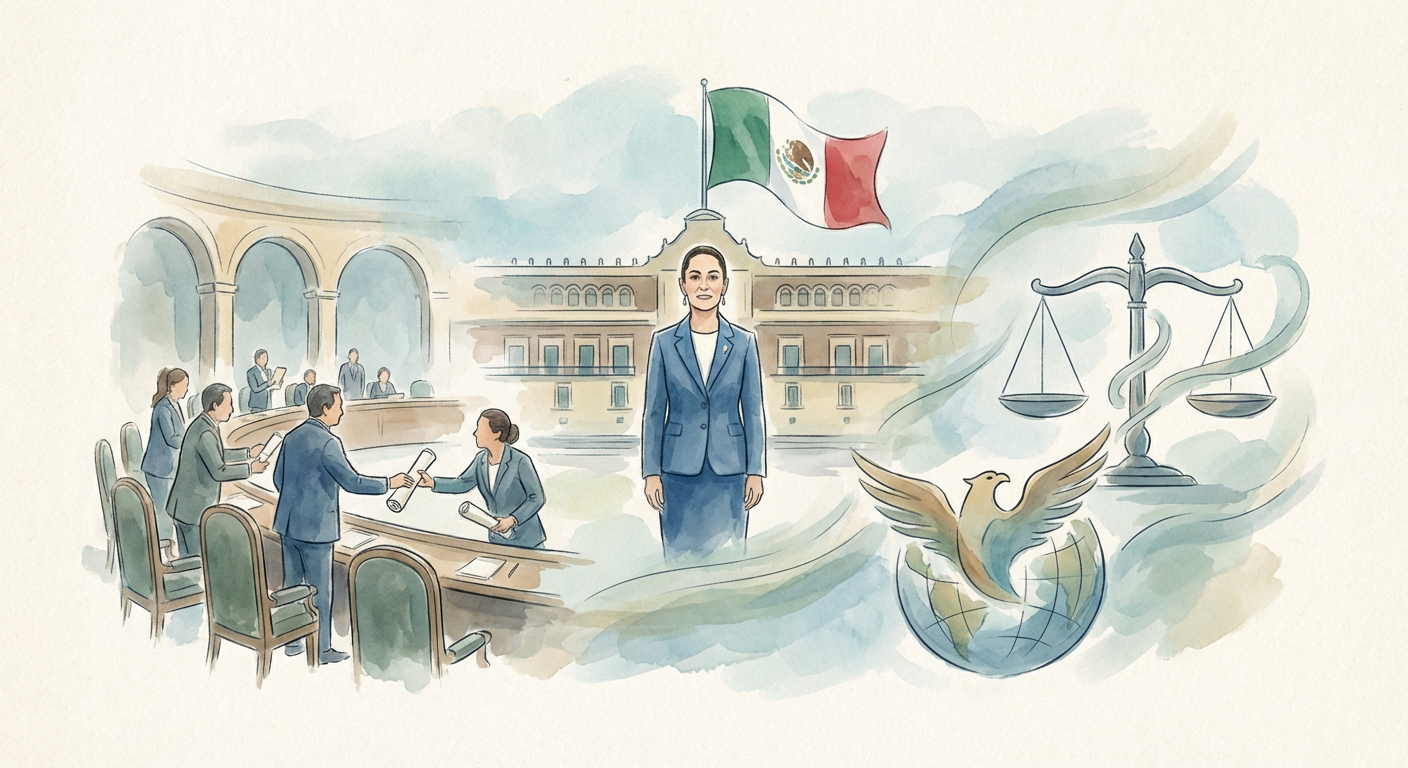
The Cartel Problem That Cannot Be Policed Away
Beneath the macro-level constitutional drama lies a more immediate and intractable crisis: Mexican cartels operate with de facto state capacity in significant portions of Mexican territory. In February 2025, the Trump administration designated six major Mexican criminal organizations, including the Sinaloa Cartel and CJNG (Cartel Jalisco Nueva Generacion), as Foreign Terrorist Organizations. This designation carries real legal weight. It constrains financial transactions, limits international movement of cartel leaders and assets, and establishes legal thresholds for potential U.S. military engagement. But designations are symbolic assertions of American intent. They do not solve the underlying problem: these organizations control territory, infrastructure, and in some regions, governmental functions.
The data on Mexico’s local political violence tells this story with brutal clarity. According to the Wilson Center Mexico Institute Political Violence Tracker, 47 sitting or recently elected local officials were assassinated between January and October 2025, the highest rate recorded in the Institute’s tracking period. Think about what that number means at ground level. A mayor or municipal councilor is murdered not for corruption or personal vendetta but because they refused to cooperate with cartel operations in their jurisdiction. They represent the state. When they are killed with impunity, the state loses authority. Sheinbaum inherited this problem, but she did not create it, and more troublingly, no Mexican president has demonstrated the capacity to reverse it.
Sheinbaum has continued her predecessor’s “hugs not bullets” security strategy, emphasizing prevention and social programs over direct confrontation. This approach has rhetorical appeal and some policy merit. But it operates on a premise that requires state capacity Mexico simply does not possess in cartel-dominated regions. Prevention requires functioning municipal governments, schools, and job programs. Social mobility requires economic opportunity. All of this requires state institutions that work. In territories where cartels have effectively captured local governance structures, Sheinbaum’s administration confronts a chicken-and-egg problem: you cannot build functioning institutions without first reducing cartel violence, but you cannot reduce cartel violence without functioning institutions to maintain order and enforce law. She is trying to break this cycle through incremental institutional strengthening and federal coordination. The results have been decidedly mixed.
The Fentanyl Corridor and the Numbers That Confound Simple Analysis
Drug seizures at the U.S.-Mexico border offer a paradox that illustrates how deceptive national-level statistics can be. The U.S. Customs and Border Protection Fentanyl Seizure Statistics recorded 27,000 pounds of fentanyl seized in fiscal year 2025. This represents significant law enforcement activity. Yet during the same period, according to preliminary CDC estimates, U.S. overdose deaths declined for the second consecutive year. These numbers seem contradictory at first. Higher seizures coinciding with declining overdose deaths could mean enforcement is working more effectively. Or it could mean the supply is so overwhelming that massive seizures represent only a fraction of total flow. Or both things could be true simultaneously.
The fentanyl crisis touches every aspect of Sheinbaum’s relationship with the United States. Washington has made narcotics trafficking reduction a central criterion for evaluating the Mexico partnership. Higher seizure numbers provide political cover for Sheinbaum domestically and internationally. They demonstrate action against cartel operations. But seizures depend heavily on where Mexican and American law enforcement focus interdiction efforts. If you increase patrols at major border crossings, you increase seizures there, but you may simply displace trafficking to other routes. Cartel organizations operate with geographic flexibility that state security forces do not possess. They have decades of experience adapting to interdiction patterns.
What complicates Sheinbaum’s position further is that fentanyl manufacturing has increasingly moved inside Mexico rather than remaining dependent on precursor chemicals from China. Mexican labs now produce the drug. This means disrupting supply requires domestic law enforcement action in cartel-controlled territory, which brings us back to the fundamental sovereignty problem. To meaningfully reduce fentanyl production, Sheinbaum would need to extend state authority into regions where cartels currently govern. The Trump administration’s terrorist designations may accelerate some pressure on financial systems, but they do not solve the core challenge: state capacity in cartel territories remains limited.
Managing the U.S. Relationship Without Surrendering Sovereignty
Sheinbaum’s relationship with Washington requires constant calibration. Mexico is not a subordinate state, yet it is heavily integrated with the U.S. economy and dependent on U.S. cooperation in security matters. The Trump administration’s approach to hemispheric relations emphasizes reciprocal concessions more aggressively than its predecessors. The terrorist designations of major cartels signal renewed willingness to unilaterally define threats rather than coordinate with Mexican authorities. This is not entirely new, but the rhetoric surrounding it is more confrontational.
Sheinbaum has navigated this by emphasizing institutional cooperation while carefully maintaining Mexico’s diplomatic independence. She has not publicly embraced the terrorist designations, but neither has she rejected them outright. She has coordinated with U.S. law enforcement on specific operations while resisting broader structural changes to Mexican security institutions. This balancing act is increasingly difficult as Washington expands its demands. Future administrations may push harder on issues like extradition, intelligence sharing, and the scope of U.S. law enforcement operations on Mexican soil. Sheinbaum faces pressure to demonstrate results on cartel disruption without fundamentally compromising Mexico’s institutional sovereignty or creating a precedent for deeper U.S. security intervention.
The Institutional Durability Question
What ultimately matters is whether MORENA can sustain its political supermajority long enough for Sheinbaum’s institutional reforms to take root and stabilize. The judicial reform, the security strategy, the approach to cartel violence and U.S. relations all depend on political support that remains present but not guaranteed. MORENA won decisively in 2024, but Mexican electoral coalitions shift. Economic performance, corruption scandals, security failures, or shifts in voter sentiment could erode that supermajority. If opposition parties gain congressional strength in future elections, they will inherit a judiciary that was remade through partisan supermajority processes and may seek

Carbon Markets: A Corporate Windfall Disguised as Climate Justice
The Carbon Offset Illusion: Why Market Mechanisms Serve Capital, Not Climate Justice

NATO’s 3% Question: Why the Hague Summit Matters More Than the Headline Number Suggests
About Author
